Call for Papers
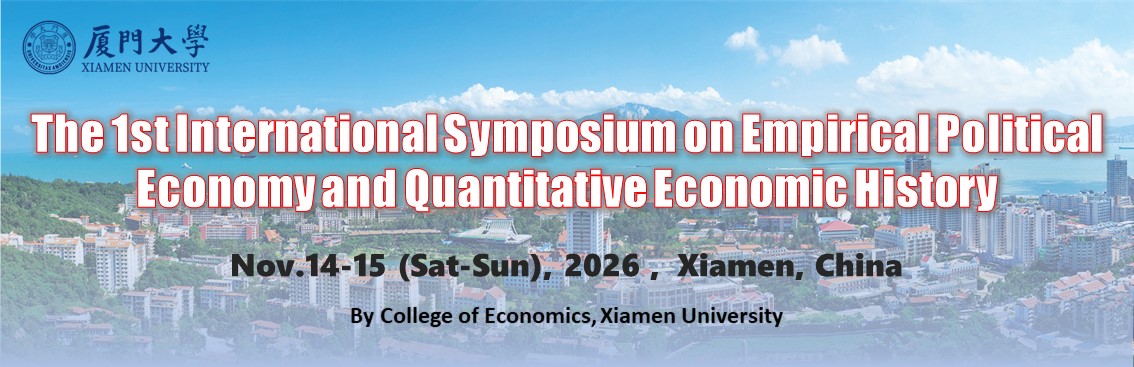
The 1st International Symposium on Empirical Political Economy and Quantitative Economic History
Nov.14-15 (Sat-Sun), 2026,Xiamen, China
By College of Economics, Xiamen University
We are pleased to announce the 1st International Symposium on Empirical Political Economy and Quantitative Economic History at College of Economics,Xiamen University, China.
We invite submissions of completed empirical research papers focused on political economy and economic history in general and in particular early-stage papers that would benefit from feedback and discussion on the following topics:
Chinese Economy
Economics of Inequality
Geoeconomics
History of Economic Thought
Empirical Political Economy
Politics and Society
Quantitative Economic History
The keynote speakers in alphabetical order include:
| Ying Bai | University of Hong Kong |
| Lin Cheng | Shanghai University of Finance and Economics |
| Raymond Fisman | Boston University |
| Matteo Maggiori | Stanford University |
| Se Yan | Peking University |
PAPER SUBMISSION
Researchers interested in participating should submit their papers through our online portal at https://conf.xmu.edu.cn/conf2026/epe.
The submission deadline is extended to October 7, 2026. Decisions of acceptance will be announced by October 15, 2026.
FURTHER INFORMATION
The registration fee is 150 USD (or 1000 RMB) for faculty/professional and 75USD (or 500 RMB) for students. This fee includes symposium materials, meals, and coffee breaks for both days. Attendees are responsible for their own transportation and accommodation expenses.
For academic inquiries about the conference, please contact Prof. Jianan Li (jianan.li@xmu.edu.cn), and Prof. Yinggang Zhou (ygzhou@xmu.edu.cn), Co-Chairs of organizing committee
For technical affairs in the submission, please contact Ms. Yuhan Chi (chiyuhan@xmu.edu.cn).
ORGANIZERS
College of Economics at Xiamen University
Xiamen University (XMU) was established in 1921 by renowned overseas Chinese leader Mr. Tan Kanh Kee. The College of Economics traces its origins to the Business Division at the founding of the university in 1921 with a long tradition of excellence in teaching and research. In the early years, Mr. Wang Yanan, the former President of XMU for 19 years and one of two renowned economists who translated Karl Marx’s Das Kapital into Chinese, guided the rapid development of the economics discipline at XMU and made Political Economy a leading field in China.
Currently, the College of Economics at Xiamen University is comprised of the School of Economics (SOE), the Wang Yanan Institute for Studies in Economics (WISE), and the Paula and Gregory Chow Institute for Studies in Economics. In September 1981, the Department of Economics was approved by the Ministry of Education (MOE) to become the first school of economics among top universities in the Chinese mainland. As a strategic initiative to internationalize economics research and education, WISE was established in 2005 with a strong focus on econometrics and other related fields. The Chow Institute, initially known as the Gregory and Paula Chow Center for Economic Research in 2016, was established in May 2022 and named after Professor Gregory Chow, a world-renowned economist from Princeton and his wife, Paula Chow.
The College of Economics at XMU is devoted to quality education, frontier research, and intensive international cooperation and strives for excellence. In 2019 ESI rankings, XMU ranked among the top 1% globally in economics and business. According to Shanghai Ranking’s Gobal Ranking of Academic Subjects 2023, XMU ranked 50th globally in Economics. In QS World University Rankings by Subject 2025, XMU ranked the 78th globally in Economics and Econometrics. In U.S. News Best Global University Rankings 2026-2027, XMU ranked 22th globally in Economics and Business.
Located in Southeast China with convenient direct flights to many major cities in Asia, Xiamen is famous for its resort like atmosphere and has a reputation as the cleanest and most livable Chinese city. Interesting places near Xiamen include the UNESCO World Heritage Hakka Earth Buildings, Gulangyu (Piano Island) and Wuyi Mountain. For more information on the city of Xiamen, please go to: http://www.whatsonxiamen.com/home.php.